Showing posts with label mathematics. Show all posts

Wednesday, 12 August 2015

Drawing Tessellations

The opportunity to combine Art and Mathematics came about while looking at Two dimensional shapes. This aspect of mathematics lends itself to some creative exploration, through repeating shapes in many different ways to create patterns. 

Two dimensional shapes can be reflected, rotated or translated so that a pattern is formed.

We created a grid consisting of 7cm squares. This took some time as we needed to be accurate so that the pattern would be effective. We then created a 7cm square grid. Shapes were drawn on two of the sides and then cut out. They were joined back to the grid. This formed our tesselating shapes. 


The shapes were then traced around on the grid. The shape was translated or moved forward to the next square and then traced around again. This was repeated until all of the grid was filled.


The students then used coloured markers or pencils to colour their tesselations in. The activity took a little longer than expected but the results have been worth it. 
The students have been able to see how a square can be turned into a tesselating shape. They also had the opportunity to know how to translate a shape in a hands on way. 
What do you know about tesselating shapes? Do you know of an artist that uses tessellations in their artwork? 

Thursday, 21 May 2015

Cuboid Challenge

Mathematics can be something of a challenge! We are focusing on the problem of Volume and Capacity. Volume is the amount of space that an object takes up. This is generally measured in cubic centimetres or metres. The capacity of an object, is the amount it can hold. This is is usually measured in grams and kilograms.

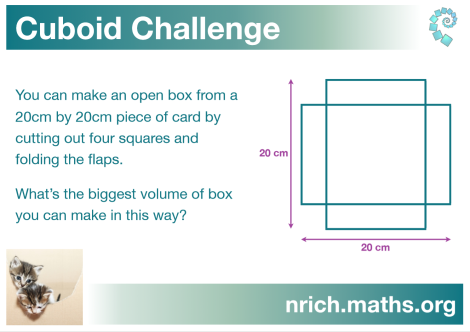
The challenge that Year 6 were given was the Cuboid Challenge, which come from a website called Nrich. The challenge was this:


It was first given to a group of students who had finished another Mathematics activity. They had the task of working out the problem and finding out what they needed to to. These students then had the task of teaching the other students what to do. 

The first task was to create a 20cm square out of a piece of paper. Then squares were cut out of the corners. Each student had to estimate the volume of their cube. We also had to estimate if the volume of the cubes would be the same regardless of the size of the squares that were cut out of the corners. We also needed to use the formula of length x width x height = Volume.

Our results were as follows:


We discovered there was a pattern with the numbers... Can you see what the pattern is?